Highlights from #WMTY17

The global campaign entitled, “What Matters to You” was held on Tuesday, June 6, 2017. In addition to a number of events happening in various locales around the world, there was plenty of action occurring online. In addition to interactive blogs, the Twittersphere saw many #WMTY17-related tweets flying about. Below are just a few of the tweets shared. Thanks to everyone who participated in this campaign. Let’s keep asking the question, “What Matters to You?”


And We’re Off!


Today, Tuesday, June 6th, is the day for you to ask and answer the following question.
“What Matters to You?”
Join in the discussion on Twitter, using the hashtag #wmty17 and on the public blog found at https://t.co/sLz6U3P5nL

What Questions Matter Most to You?


If you are from Alberta, have lived experience with depression, and are interested in depression research, you may wish to participate in an online survey conducted by Alberta SPOR SUPPORT Unit, Patient Engagement Platform, Alberta Health Services and Canadian Depression Research and Innovation Network. By completing this survey, you will assist in determining the top 25-30 depression research questions to be used for an upcoming workshop. What questions matter most to you?

Click here to participate in the survey.

Let Your Voice Be Heard


On Tuesday, February 28th, Red Deer doctors held a public meeting to discuss the deficiencies at the Red Deer Regional Hospital.and the impact they were having on patients and the care they received. In 2014, there was a plan to address these issues, which included redeveloping the hospital. However, in late 2016, Alberta Health Services removed this redevelopment plan from its list of priorities. This they did even though the Red Deer Regional Hospital is the fourth busiest in the province, is in need of “96 more admitting beds, 8 more emergency room beds and three more operating rooms.” In a notice issued by the doctors, “‘If you find the treatment of central Albertans by policy-makers and government unacceptable and unfair, let your voice be heard.'” Click here to read more.

Research over People?

Living with a chronic condition can result in a number of challenges, including alienation, isolation and loneliness. Oft times, these factors can be more problematic than the condition itself. 

Fortunately, there are disease-related organizations that can assist individuals with their illness as well as other the challenges, such as those noted above. Sadly, some of these organizations are forfeiting these services in pursuit of a “cure.” As such, the person with the disease is becoming secondary to the disease itself. Click here to read what individuals with MS are facing.

What is QI?

The use of acronyms and abbreviations is common in many areas, including healthcare. One acronym often found in written material and heard in conversations is QI. However, what does QI mean? Health Quality Ontario created the following video that highlights the key points of the QI – Quality Improvement – as it relates to healthcare. More specifically, what does QI mean in healthcare and why should we care about it? If you have not seen the video, you may wish to do so.

Have Your Say

Do you have some thoughts and ideas of how the healthcare system in Alberta could be improved? Do you have a vision of healthcare that you would like to see become a reality? If so, Alberta Health Services and Alberta Health are wanting to hear from you.

The goal is to co-design and co-deliver a sustainable, quality health system, one that promotes healthy communities and provides access to services, programs and facilities.

From fall 2016 to fall 2017, the focus is on Calgary Zone and Central Zone long range planning. This follows planning undertaken in the Edmonton Zone, which is ongoing; the province’s North and South Zone planning will follow.

Join the conversation. Share your ideas and help us develop a vision for health services in 15 years that informs decisions today. Planning for each zone will be incorporated into system planning for the province. All Albertans are encouraged to contribute to the discussions.

Click here to continue.

Do Buildings Have Rights?

If you have been following the assisted dying discussion that is happening in Canada, you know that some patients have been denied medically assisted dying. The reason for this was not because the individuals failed to meet the necessary legal requirements, but because the hospitals/care facilities in which they found themselves would not provide the services to carry out the patients’ wishes.

In a recent article, André Picard argues that hospitals have no right to refuse a patient assisted dying. As he poignantly states:

It is reasonable for individual physicians and nurses to declare a conscientious objection and not participate in assisted death. But a hospital or nursing home has no such right. Publicly funded institutions cannot arbitrarily decide what services they will provide, nor should they be able to shunt dying patients around like sacks of rice.

Click here to read the full article.

Patient First?

patient-x-art
“Patient first” is a term that is often used in the health-care sector. However, are we first and foremost patients? Is that how we see ourselves?

According to Dr. Jordan Asher, he sees his patients differently. To him, he sees them as people first. “[I]n order for you to have a better health status, which includes healthcare, I need to think about you as a human being…We don’t look at people as diabetics; we look at them as people that have a bunch of life issues that happen to have diabetes.” How does this philosophy influence the manner in which Dr. Asher works with his patients? Click here to find out.

Call for Participants

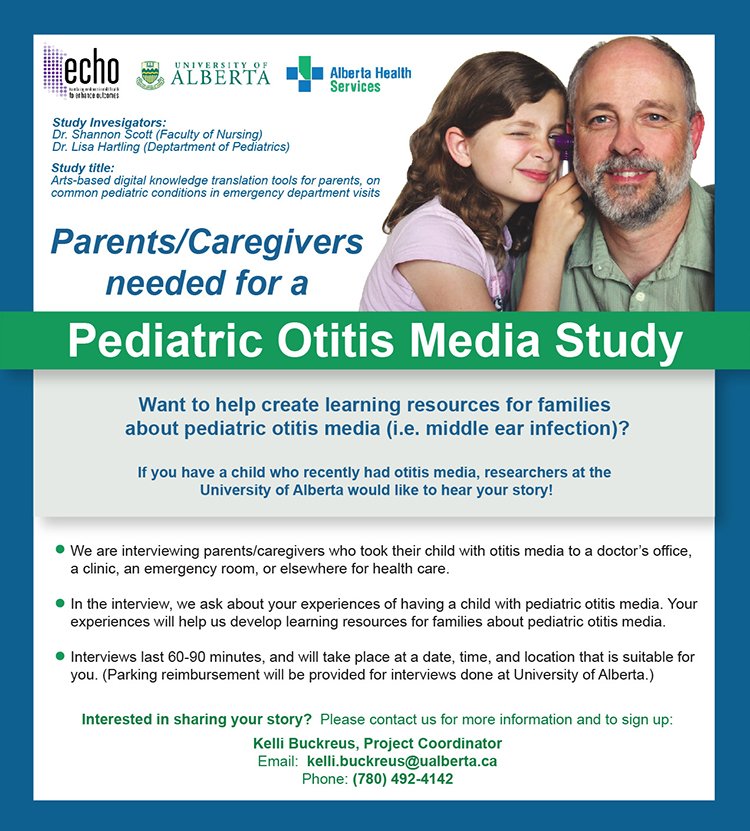
Are you a parent or caregiver of a child who has experienced an inner ear infection or other related ear problem? Would you like to help develop educational resources for parents and caregivers concerning this topic? If so, a research team at the University of Alberta are looking for you. Click on the image below for more information.