Trapped inside her own body

Imagine being conscious of what is happening around you but not being able to respond in any way. Imagine listening to doctors talk about you and the grave prognosis they held for you, without them realizing that you could hear every word.  You want nothing more than to tell people that you are okay but there is no way to do so because you are not asleep but not awake.  This is the reality Brisa Alfaro found herself in. Click here to read Alfaro’s story.

At 32, Brisa Alfaro experienced a brain-stem stroke, one that leaves patients paralyzed but painfully aware of the world.( National Post)

Survey: Pain Patients and Treatment at Hospitals

pain treatment
Over 1250 acute or chronic pain patients participated in an online survey by Pain News Network and the International Pain Foundation that focused on hospital pain care. Based on the results obtained, many pain patients felt that the treatment they received from a hospital was far less than ideal. As one pain patient stated, “It’s so bad that I will not seek treatment in an ER or hospital unless I really feel like my life is in jeopardy. They do not get it, they do not listen, and they do not care.” Another individual wrote, “I refuse to go to ER. It will end up killing me because I know how sick I am, but I would rather die than deal with ignorant, condescending doctors and nurses.” To read more about this study’s findings, click here.

An Interview with Clay Jonathan – Depression Comix

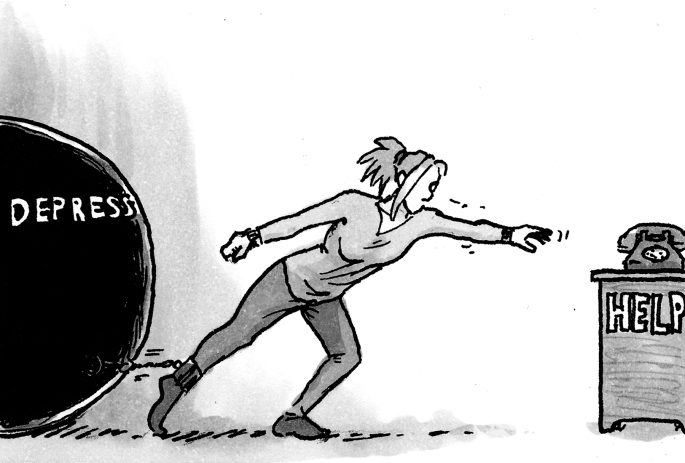
Clay Jonathan is the creator and artist behind the webcomic Depression Comix. Through his illustrations, he attempts to express some of the feelings, challenges and complexities associated with depression. As he says about the illustration above:

In this comic, the character tries to get help, but is weighed down by depression in a symbolic way. Her mother is unaware of the struggle and tells her that if she was really suffering, she’d pick up that phone and get help. I think a lot of people feel this way. They suffer in ways their friends and family can’t see or understand, but are treated like they aren’t trying. This is really frustrating and demotivates you further. Getting help is not as easy as some think it is.

Click here to read the full article.

What Does, “Like Family” Mean?

familyWhen talking about Family Presence, it is not uncommon for people to mention that the individuals whom they would want to be present with them in a hospital are not legally family members but are instead individuals who are “like family.” However, what does this terminology really mean?

While interviewing individuals for her latest book on friendship, Deborah Tannen frequently encountered the phrase, “like family.” As Tannen explains, “My friends are the sisters I was meant to have,” a woman told me. Another said that her friends are more precious than her sisters because they remember things from her past that her sisters don’t and can’t, since they weren’t there. And a man commented that he didn’t enjoy a particular friend’s company all that much, but it was beside the point: “He’s family.”

Through comments such as these and the descriptions and explanations people provided, Tannen garners an understanding of friendships, relationships and the concepts of family and “like family.”

Click here to read Tannen’s article.

ABC News: Health students doing ‘high-level tasks’ without training or supervision, union says


According to the Victorian Allied Health Professionals Association, the Victorian Government in Australia is placing patients at risk due to staff shortages. To address this staffing problem, individuals, who lack the necessary training, are performing “high-level tasks.” As the union explains, “Patients in need of x-rays, physiotherapy, occupational therapy and other allied professional services are being routinely left to the care of unqualified students and undertrained interns because there is not enough money in the system to support properly qualified staff and appropriate supervision.”

Although the story is Australia based, might this be happening elsewhere? Click here to read the article.

A glimpse into the life of an ICU nurse

What would it be like to be an ICU nurse? Below is the introduction to a blog post that provides some insight into this question.

We received a MET call (Medical Emergency Team) from the general ward to immediately come and assist. The patient’s name was Mr. ‘Stevens’. He was 81 and was in our hospital due to severe exacerbations of COPD. He was in acute respiration distress and had a low blood pressure. There was no time to discuss whether he should come to the intensive care unit or not. Mr Stevens had never discussed this before with his doctor, nor with his sons and in this moment of distress, it was now an option for him. The only thing that was clear was that he wanted to be relieved of his shortness of breath, his pain and his anxiety. There was no chance to talk about the consequences of the decision to enter intensive care. The urgency of the situation forced him to just accept it.

However, in his eyes you could see that he had much to say… there were words that he couldn’t get out, things he wasn’t able to say when he arrived. We all knew this when we saw him coming in to our unit. We could see the emotion, bubbling under the surface, all the feelings he wanted to express, but couldn’t any longer, simply restrained by his utter weakness in the final hours of his life.

Click here to continue reading.

Eager to Volunteer at 90

Mrs. Mary Margaret Sims turned 90 years old on Saturday, March 26th and is a long-time volunteer in her community. In addition to volunteering for Meals on Wheels, she is also a volunteer at the local cancer society thrift shop. According to Mrs. Sims, “Serving others gives us self-satisfaction…It makes me feel good.” Click here to read the full story.

Insight into Insite

nytinsite

Insite is the first legal supervised interjection site in North America.  Located in Vancouver, Canada, people can inject drugs in a safe place that is health focused.  The goal of Insite, which is operated and funded by Vancouver Coastal Health, is to “decrease the adverse health, social and economic consequences of drug use without requiring abstinence from drug use.” (http://www.vch.ca/public-health/harm-reduction/supervised-consumption-sites Continue reading →

We Know the Senior Population, Right?

When one hears the word seniors, oft time images arise in one’s mind of someone who is frail, bent over due to osteoporosis, listless and lethargic, confused and lacking in mobility. Not surprisingly, such assumptions and stereotypes affect how we see and treat seniors.

Recognizing this, Michelle Gibson, a professor at Queen’s University in Kingston, Ontario, challenges her first-year medical students’ assumptions of seniors and geriatric medicine through the use of You Tube videos. According to Gibson, “All the videos are of “regular” seniors- not famous folk, by design. I will only show videos where seniors are treated like adults, with respect. (This means there are many news interviews I won’t use, sadly, because they often have a patronizing ‘yes dear’ tone to them that I can’t stand.)”

Below is one of the video Gibson uses in her class.

Click here to read Gibson’s article and watch some more of her videos.

If Doctors Are Kind to Each Other, Patients Benefit Too

Negative relationships can exist between physicians and their presence can impact patient care. As Dr. Karthikesan explains, “The doctor-patient relationship paradigm depends closely on the doctor-doctor relationship. Bad and damaging cultures foster a hostile atmosphere that erodes trust, tarnishes good communication and promotes disrespect within the medical community. The role doctors play in harming each other ubiquitously affects the patient’s care, however unintentionally. The question becomes, how can the relationship between physicians be improved or as Karthikesan asks, “So what went wrong in the noblest of professions and how do we fix it?”

Click here to read the solutions proposed.