Are you….
- 14-20 years of age?
- a person who suffered a concussion within the past two years?
- interested in concussion research?
- wanting to help others?
If so, you may find this YouTube video of interest.

Are you….
If so, you may find this YouTube video of interest.

With the cold and flu season upon us, flu shot clinics have sprung up in a number of locations, including grocery stores, pharmacies and in shopping malls. Related to these clinics are the discussions and debates around the topic of immunization and vaccination. Should a person get a flu shot? What are the risks of getting a flu shot? What are the risks associated with not getting one? Below is a tweet that contained statistics from the US concerning immunization and vaccination.
Annual US Morbidity From Common Diseases Before and After Vaccines.#health #medicine #vaccines #vaccination pic.twitter.com/v9uA8HGPQc
— Disease Symptoms (@DiseaseSymptom) May 10, 2014
The Government of Canada has also developed the Canadian Immunization Guide that provides information about immunization. In addition, there are numerous websites, including New Health Advisor, which discuss the pros and cons of vaccinations and immunization. One thing for sure, there is no shortage of information concerning vaccination and immunization debate. On which side of the debate do you fall?

Are you interested in promoting and improving the safety and quality of Alberta’s healthcare system? Do you want to see changes in this area? If so, the Health Quality Council of Alberta is looking for volunteers to join its Patient/Family Advisory Panel. Click here for more information.
 The term “patient engagement” is one that is frequently stated and bantered about. However, what does it really mean? Why is such engagement important? How can patient engagement be fostered and promoted, so it becomes more than a theoretical idea or ideology and something that is real and realized?
According to Dr. Anhalt, an individual who treats pediatric patients with type 1 diabetes and chief medical officer for T1D Exchange, patient engagement is critical. Among other things, it sees patients becoming engaged in their own care, resulting in living healthier lives and experiencing better outcomes. Based on this understanding, Dr. Anhalt discusses tips for successful patient engagement. They include: educating patient and families, encouraging patients to engage in their health outside of a doctor’s office and using all patient interactions as opportunities for learning. To read the full article, click here.

Although the following is a work of fiction, Patricia Bath (author) states, “[T]he situation explored may be all too common.” Without further adieu, let the story begin.
Beep. Beep. Beep. There’s a slow, rhythmic sound next to my head. I’ve never heard a sound like it before. I hear a whoosh on the other side of me, and at the same time I feel pressure in my chest, like a balloon that on the verge of popping.
It only lasts a few seconds and the pressure is gone. My chest returns to normal and I immediately feel better. Something squeezes my left arm tight—so tight that I want to yell. But I can’t make any words come out.
Then, just as quick as the pressure in my chest came and left, so does the pinch around my arm. I don’t know where I am, but I feel like I’m being tortured.
“I know that it’s cold in here, but I’ll use this warm blanket to keep you warm,” says the strange voice, belonging to a person I can’t see.
Who are you, I try to ask. But just as the darkness around me persists, so does my inability to speak. I have no idea where I am, and I’m scared.
The voice comes back, “Ok, it’s time to roll on your side.” I feel someone tug on my left side and roll me onto my right. A new beeping starts: this one sounds angry, like something’s wrong. I want to ask but I can’t make the words come out. I feel what I think is water and a washcloth on my backside and I’m overcome with embarrassment.
Why is this stranger washing me? I feel the sensation of rubber being dragged across my left side as I hear a different voice say, “Hey, I’m dropping her here. Are you almost done?” There’s a little push on my back and the rubber stops tearing at my left side.
click here to continue reading.
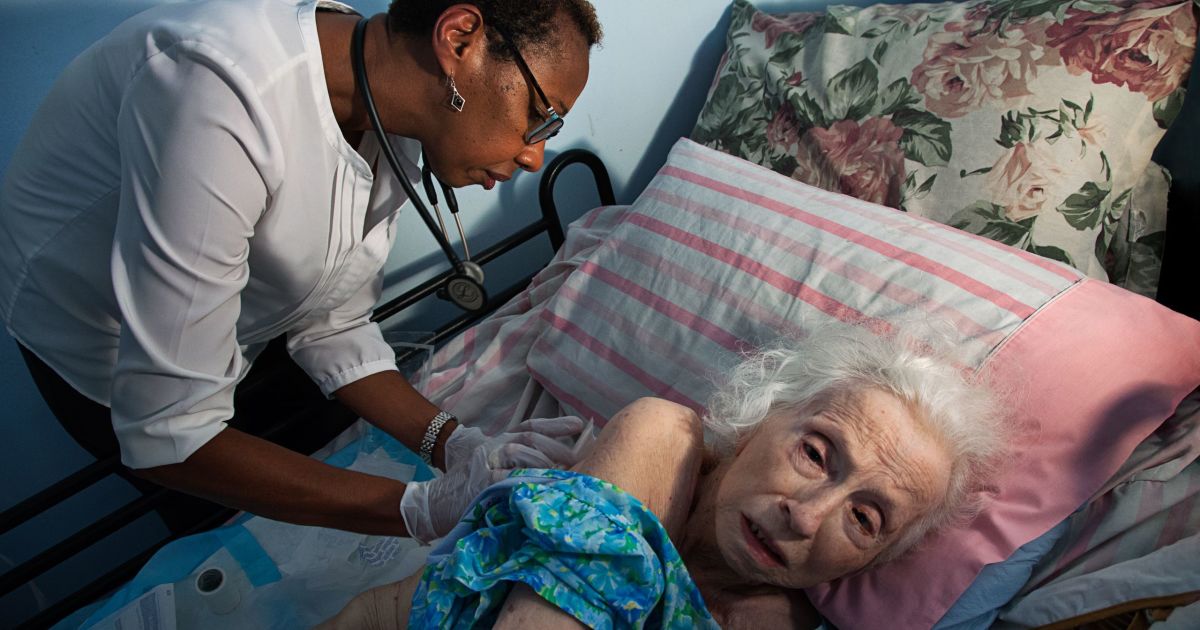
Meet Heather Meyerend, a hospice nurse who works in South Brooklyn. As such, Heather addresses people’s physical, emotional, psychological and spritual needs when they are most vulnerable.
She sees her work as preparing a patient for the voyage he is about to take, and accompanying him partway down the road. She, like most hospice workers, feels that it is a privilege to spend time with the dying, to be allowed into a person’s life and a family’s life when they are at their rawest and most vulnerable, and when they most need help. Some hospice workers believe that working with the dying is the closest you can get on earth to the presence of God.
Click here to continue reading.
 Family Presence is becoming an important topic in Alberta’s healthcare system. As such, we have added a Family Presence area to our website. There you will find some new material that is hot off the press! Click here if you are looking for Family Presence tips, conversation starters and more…
Do you live in British Columbia? Do you want to make a positive difference to the province’s health care system? If so, you may wish to explore the Patient Voices Network. Ernie Hamm is an individual who chose to do just that and is very happy that he did.

Ernie Hamm loves to lend a helping hand and he’s been thoroughly enjoying donating his time with the Patient Voices Network (PVN). The Osoyoos senior, 77, has been volunteering with PVN for more than four years and has loved every minute of it. “I just volunteer in any area where they need help,” he said. … Click here to continue.

If you live in or near Vernon, British Columbia and are interested in improving health care, this may be of interest to you.
The Patient Voices Network is in search of volunteers in Vernon.
The Interior Health residential care framework redesign advisory committee is looking for 10 to 14 volunteers to share experiences they’ve had with the health care system in order to provide feedback to the institution. “It’s through a patient lens,” said Carol Stathers, PVN Okanagan engagement leader.
The volunteers may also help with putting together patient educational pamphlets.
Click here to continue reading.

In an online post, Sheila, a member of the Pts4Chg community, raises an important topic. How does one obtain assistance for oneself or others when it comes to health care? How does one
tactfully get help for yourself or a loved one, or even possibly someone we don’t know who is in the hospital and we see that he/she is not getting the care that the Dr. prescribed, such as meds being missed or denied, patient not being fed, etc. Sadly, only those who have a loved one who comes to visit, will get these issues fixed, but I have seen (too many times) meals delivered to people without a loved one there to feed them, which were just picked up and taken away when the dietitians came back to collect trays, no one to feed those who are the most sick and alone or help them get the care the Dr. prescribed. In my local hospital, those with visitors get the most care because then there are ‘witnesses’ to what did or did not happen. The ones who are alone are in a dangerously negligent position.
Any comments and suggestions relating to this topic are welcome.
