
A Doctor’s Stance

istock_65198665_medium
There is much discussion occurring in Canada and elsewhere around the issue of assisted dying. Not surprisingly, oft times, the conversation becomes a religious debate.

In a recent article found in the Globe and Mail, Jonathan Reggler, a general physician who makes daily patient visits to St. Joseph’s Hospital in Comox, B.C., took a stand against the hospital’s assisted-dying policy. While it is true that Catholic hospitals across the country are transferring patients who request assisted suicide to facilities where this can occur, the process can involve a great deal of emotional, mental and physical pain to the patient and his/her family. With such suffering being inflicted on the patient and the fact that the service requested is being carried out elsewhere, the question being asked is: Should faith-based hospitals should receive public funding? As Daphne Gilbert, a law professor at the University of Ottawa, states, “The Catholic hospitals have put themselves in a tricky position.” Click here to read the full article.

Thank You

Thank you to everyone who joined us in the Fishbowl last night. What a great time and and an interesting conversation! Special thanks to our fish – Debbie, Mike, Aaron, Sandi, Philip, Terry, Jane and Kristina. You were super! Thanks also to Richard. Your efforts in bringing this event about were not overlooked and were much appreciated. Thanks so much! Tracyweb-fish-thank-you-front

Into The Fishbowl

fish-bowl-600

Are you interested in patient/provider partnerships (e.g., What they are? How they can be created? What barriers exist that impede their development?) If so, you may wish to join the Patent 4 Change Fishbowl session, which is being offered as part of Alberta Health Services’ Patient & Family Centred Care Week. The session will be held via phone and Internet and is open to all. Click here to read more about the Fishbowl session. Don’t miss out on what promises to be a very engaging experience. Register here.

Call for Participants

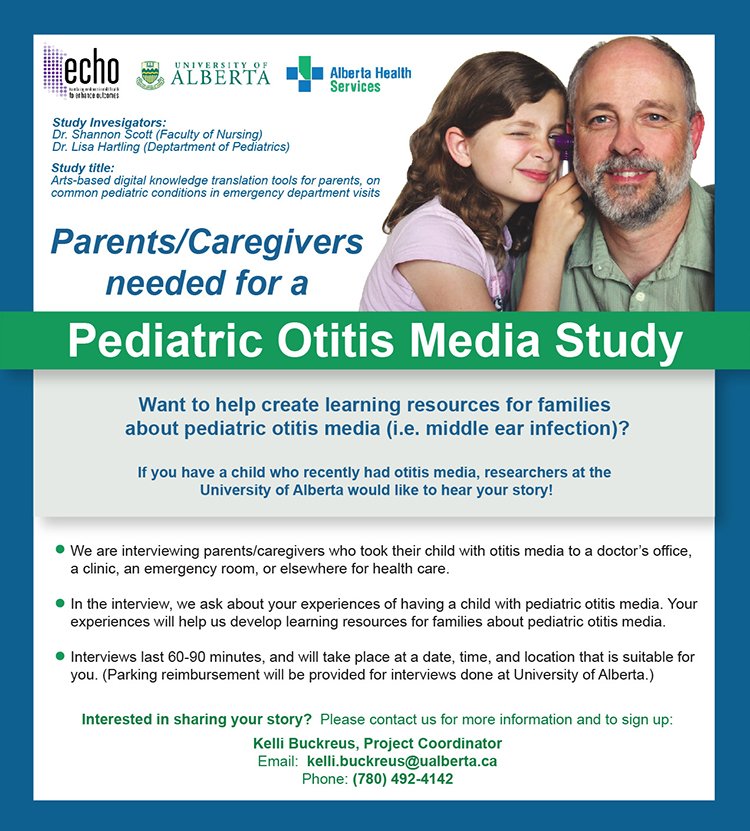
Are you a parent or caregiver of a child who has experienced an inner ear infection or other related ear problem? Would you like to help develop educational resources for parents and caregivers concerning this topic? If so, a research team at the University of Alberta are looking for you. Click on the image below for more information. 

Managing Chronic Conditions by Making Connections

connection

What do Livongo, MyHealthTeams, Health Decision Technology, Wellness Layer and Sensely have in common? In addition to them all having an online presence, they are also focusing on chronic disease management. Key to this management, or more specifically self-management, is to help people with chronic diseases, or loved ones with such conditions, connect with others – patients, coaches, etc. Through these connections, the hope is that the financial and physical burden being experienced will be reversed or in someway lessened.  Click here to discover more about these initiatives.

Tips for Patient Engagement

alexanderrathsThe term “patient engagement” is one that is frequently stated and bantered about. However, what does it really mean? Why is such engagement important? How can patient engagement be fostered and promoted, so it becomes more than a theoretical idea or ideology and something that is real and realized?

According to Dr. Anhalt, an individual who treats pediatric patients with type 1 diabetes and chief medical officer for T1D Exchange, patient engagement is critical. Among other things, it sees patients becoming engaged in their own care, resulting in living healthier lives and experiencing better outcomes. Based on this understanding, Dr. Anhalt discusses tips for successful patient engagement. They include: educating patient and families, encouraging patients to engage in their health outside of a doctor’s office and using all patient interactions as opportunities for learning. To read the full article, click here.

End-of-life Decisions

Although the following is a work of fiction, Patricia Bath (author) states, “[T]he situation explored may be all too common.” Without further adieu, let the story begin.

Beep. Beep. Beep. There’s a slow, rhythmic sound next to my head. I’ve never heard a sound like it before. I hear a whoosh on the other side of me, and at the same time I feel pressure in my chest, like a balloon that on the verge of popping.

It only lasts a few seconds and the pressure is gone. My chest returns to normal and I immediately feel better. Something squeezes my left arm tight—so tight that I want to yell. But I can’t make any words come out.

Then, just as quick as the pressure in my chest came and left, so does the pinch around my arm. I don’t know where I am, but I feel like I’m being tortured.

“I know that it’s cold in here, but I’ll use this warm blanket to keep you warm,” says the strange voice, belonging to a person I can’t see.

Who are you, I try to ask. But just as the darkness around me persists, so does my inability to speak. I have no idea where I am, and I’m scared.

The voice comes back, “Ok, it’s time to roll on your side.” I feel someone tug on my left side and roll me onto my right. A new beeping starts: this one sounds angry, like something’s wrong. I want to ask but I can’t make the words come out. I feel what I think is water and a washcloth on my backside and I’m overcome with embarrassment.

Why is this stranger washing me? I feel the sensation of rubber being dragged across my left side as I hear a different voice say, “Hey, I’m dropping her here. Are you almost done?” There’s a little push on my back and the rubber stops tearing at my left side.

click here to continue reading.

Patient Voices Network – Volunteer and Make a Difference

Do you live in British Columbia? Do you want to make a positive difference to the province’s health care system? If so, you may wish to explore the Patient Voices Network. Ernie Hamm is an individual who chose to do just that and is very happy that he did.

Ernie Hamm loves to lend a helping hand and he’s been thoroughly enjoying donating his time with the Patient Voices Network (PVN). The Osoyoos senior, 77, has been volunteering with PVN for more than four years and has loved every minute of it. “I just volunteer in any area where they need help,” he said. … Click here to continue.

Are patients the health care system’s free labor?

Have you ever felt overburdened by the amount of paperwork, phone calls, e-mails, appointments, etc., associated with navigating the health care system?  If so, you are not alone.

stress1

In the article, “Unpaid, stressed, and confused: patients are the health care system’s free labor,” Sarah Kliff describes how the health care system can place considerable burden on the patient him/herself. This realization came about from her own experience managing a chronic foot injury. As Kliff explains:

What I didn’t understand was the burden patients face in managing the health care system: a massive web of doctors, insurers, pharmacies, and other siloed actors that seem intent on not talking with one another. That unenviable task gets left to the patient, the secret glue that holds the system together.

For me, this feels like a part-time job where the pay is lousy, the hours inconvenient, and the stakes incredibly high. It’s up to me to ferry medical records between different providers, to track down a pharmacy that can fill my prescription, and to talk to my insurance when a treatment gets denied to find out why.

Click here to read the full article.
Poll: Social Media and Confidence